Question: I do not understand #12 and #16:

Question: Can you show how to do some Punnett Squares (2/5/2012):
Sure can. Let's first look at something about genetics:
When you get a trait from a parent (sometimes) you deal with one dominant gene and one recessive gene. Now why do we deal with two "genes"? Because you have two people each giving a gene for one trait (1+1=2)
Dominant and Recessive? Lets just think of it this way:
A = Dominant (A is capital. He's strong and all As want their way.)
a = Recessive (a is lower case. He's weak and wants his way, but if there are any Capital As around he'll loose)
So we have 3 possibilities - AA, Aa, aa
Whaaa so why do we deal with four total letters? Cause just like you get two genes from each parent, your parents got two genes from their two parents and so on. Therefore, we have to deal with the fact that the mom and the dad both have two genes (2 + 2 = 4)
Punnett Square Creation:
Place the two genes from each parent in a box that has 4 areas.
Bring the Top letters down to both boxes (Straight down in their column)
Bring the Side Letters over to both boxes (Straight Across in their row)
Always Place the Capital Letter in Front
So lets look at a few examples I threw together -


Question: I don't understand the scientific method, the order confuses me sometimes. (2/5/2012)
Is the scientific method that complicated? No, not really. Though it does take two things to make sure you have it down right.
1st: The order in the scientific method
2nd: Understanding what the order means to actually apply it to something.
Order:
- Observation
- Hypothesis
- Experiment
- Results
- Conclusion
Other "Stuff":
- Independent Variable - The thing you change
- Dependent Variable - The thing you measure
Now how to apply the scientific method? Lets think of a situation and apply it in common language.

Lets say you're walking down the street and you make an observation that there are a lot of people standing in line to get into a restaurant. You're hungry and want good food so you make the hypothesis that if people are standing in line for food, that the food must be good. You then experiment by waiting in line with the others to get the same food. The results were that even though you waited forever for the food, the food tasted good. Therefore you made the conclusion that there was a long line because the food was good.
- What was your independent variable? The restaurant you chose.
- What was your dependent variable? You measured how well the food tasted. Oh, by the way that's a qualitative measurement since you rated food quality, you didn't measure a number (Quantitative - Think Quantity or Amount)
Question: I don't understand elements what makes up an element? (2/3/2012)
What makes up an element? Elements are really just a substance of "stuff" that can't be broken down anymore. A single atom of something like Calcium, Hydrogen, or Helium cannot be broken down to a smaller "thing", and they have their own property.
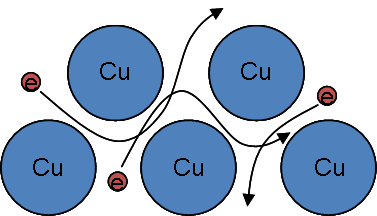
For example if we look at a picture of copper metal below, it has certain properties that make it unique. The color, how easy it is to bend, the melting point. All of that has to do with the atoms that make up the copper metal... Copper metal is actually a bunch of copper atoms (tiny) close together and they all share the same property, therefore we place the name of copper (Cu) on the periodic table and it is a unique element by itself.
Side Note: In the picture below we see Copper Atoms close together. The little (e)s you see are electrons moving around. Copper is happy with its own electrons so electrons can move around freely without being snatched up by the copper atoms. This is why copper is used for wiring in electronics much of the time, because it is a great conductor! (It allows electrons to flow through without problems)

Below you will see a form you can fill out and submit if you are confused on a topic that might show up on your NWEA science test on Monday 2-6-2012.
Use your Perfection Learning Booklet and scan through the sections and examples.
If you are in 7C or 7A you took the example test on Friday 2-3-2012 in the booklet and were given the key at the end. You were to circle the questions you got wrong, that's a great place to start to give you an idea of what you may be confused about.
Again, THIS IS ANONYMOUS. That means you do not have to give your name, though I can't respond to you if you don't give me enough information.
Good Question Example: "I don't understanding punnett squares and AA Aa aa. Can you explain that"
Bad Question Example: "I don't understand science" (isn't enough information)
Responses will be given in a video response to your question with given examples or in a written tablet form depending on the depth of the question.

CONDUCTION
Conduction is the transfer of energy through solid matter from particle to particle. Heat is conducted through a solid material much the same way electricity is. Conduction is slowed by insulation. (Direct Touch)
CONVECTION
Convection is the transfer of heat energy through a gas or liquid by movement of currents. Heat is carried by the fluid. When warm air comes out of a register, it rises. This action is called thermal buoyancy. As it cools, it falls. This rising and falling movement is called convection current. Convection can be interrupted by a physical barrier. (Movement of Hot Air / Liquid)
RADIATION
Radiation is electromagnetic waves which directly transport heat energy through space. Sunlight is radiated through space to our planet without the aid of fluids or solids. Through radiation, the sun transfers heat through 93 million miles of empty space! Heat energy transferred through radiation can be interrupted by a material which reflects it. (Heat through waves)
Also Check Out: Bill Nye - Heat Transfer Video


Here are some great links for practice on the Science ISAT Examination for 2012.
Note - Your student / You will be taking the NWEA Examination on 2/6/2012. This will show Fall to Winter Growth. The normative data for 2011 shows a general goal of around 210 for science. However, your score might be different based on what you got in the fall.
General ISAT Practice
2011 ISAT Science Questions
Information About NWEA Science

The following answers are to be used with the practice packet given on Friday 1-27-2012
The purpose of giving the answer key is so you can identify which problems you had an issue with. Please circle the problems that you had difficulty with so we can review on 1-30-2012.
Answers:

Now that you have selected an experiment, you can now identify the main topic of research.
Today's task is to find general research information related to your topic. A rough outline will be given for your setup of your research paper.
Primary Links:


